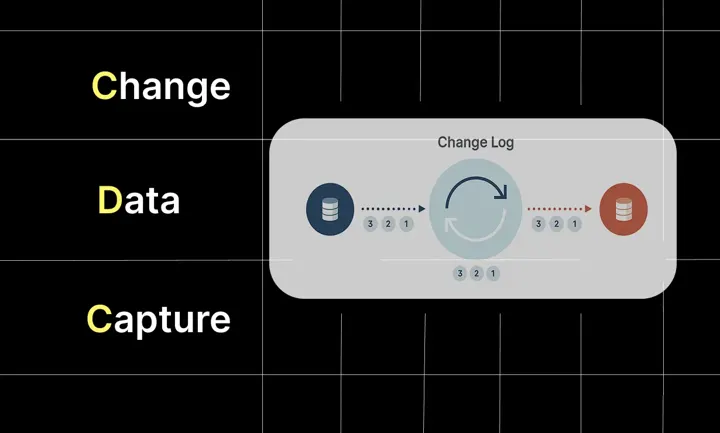
This article presents a more agile approach to get closer to real time: to only circulate changes in a reliable and scalable way. Before we go any further, let's first look at what's called modified data capture (CDC).
Change Data Capture (CDC) refers to a set of mechanisms that detect, record, and transfer only the changes made in a data source to target systems (data warehouses, BI tools, streaming applications, etc.). Instead of reloading entire datasets, CDC replicates the deltas (inserts, updates, deletes). As a result, downstream platforms have up-to-date information while reducing network load and processing costs.
Benefits of Change Data Capture (CDC)
Adopting CDC is more than a technical optimization; it fundamentally reshapes how data moves and is used across the organization. By capturing and propagating changes as they occur, CDC delivers major gains in speed, efficiency, reliability, and scalability.
BENEFIT
DESCRIPTION
Speed and real-time decision-making
By making data usable as soon as it’s created, CDC eliminates the delay between a business event and action. In finance, it enables real-time fraud detection and blocking; in retail, instant inventory adjustments; in logistics, flow optimization in response to disruptions. Organizations thus move from a reactive approach to a proactive strategy powered by continuous analytics.
Efficiency and resource optimization
Unlike batch processing, CDC,especially when based on transaction logs,limits the impact on source systems. The result: less load on production servers, no more maintenance windows for massive loads, and optimized ETL pipelines that process incremental streams instead of full datasets.
Data reliability and integrity
CDC captures each change in chronological order, ensuring strict consistency between source and target. Advanced solutions add exactly-once processing and automated error handling, which are essential for financial reporting and compliance.
Migration and synchronization with no downtime
Continuous transfer of changes to cloud or hybrid environments enables database migrations without downtime or service disruption. Source and target remain synchronized until the final cutover, ensuring a smooth and secure transition.
Better performance for AI and advanced analytics
Up-to-date data powers AI models, search indexes, and CQRS architectures (including RAG), improving result relevance and response speed.
Scalability for modern architectures
Designed for high volumes and distributed environments, CDC fits naturally with microservices and stream processing (for example, Apache Kafka), enabling robust, extensible data pipelines.
Methods of Change Data Capture (CDC)
There are several approaches to implementing CDC, each with its own advantages, limitations, and specific use cases. The choice depends on the type of database, performance constraints, and business requirements
1CDC based on transaction logs (Log-based)
Principle , Directly read the transaction log (INSERT/UPDATE/DELETE) via a binlog reader, without querying the tables.
Advantages
Minimal impact on production
Exact operation order, high fidelity
Highly scalable, near real time
Limitations
Access to logs may be restricted (managed cloud)
More technical to set up
Best for: real time, high volumes, critical environments.
2Trigger-based CDC
Principle , Table triggers write each change to a dedicated “shadow” table.
Advantages
Compatible with most relational DBMS
Fine-grained traceability and easier auditing
Limitations
Write overhead
Less suitable for very high throughput
Best for: relational applications, simple auditing needs.
3CDC via timestamps / version columns
Principle , Filter using LAST_MODIFIED, a sequential ID, or a low watermark (e.g., XMIN).
Advantages
Simple to deploy if the column already exists
Fast to implement
Limitations
Does not detect physical deletes
Increased load if queries are frequent
Best for: moderate volumes, when strict ordering isn’t required.
4Difference-based CDC
Principle , Compare two complete snapshots of a dataset to identify differences.
Advantages
No schema changes required
Simple concept
Limitations
Very resource-intensive
Unsuitable for large volumes
Best for: small datasets, ad-hoc needs.
5Polling / query-based CDC
Principle , Periodically query the source (joins, timestamps) to detect changes.
Advantages
Easy to implement
No low-level access required
Limitations
Higher latency
May load the database if volumes are high
Best for: non,real-time cases, POCs/prototypes.
6Built-in Change Tracking in database engines
Principle , Native DBMS mechanism (e.g., SQL Server Change Tracking) to track modifications.
Advantages
No triggers or direct log access required
Simple deployment
Limitations
Depends on the database engine and its limitations
Less flexible
Best for: compatible environments seeking simplicity.
Use cases of Change Data Capture (CDC)
Here are the main scenarios where CDC delivers tangible value.
1. Real-time warehousing and analytics
CDC continuously feeds data warehouses and data lakes by transferring only the changes instead of reloading full datasets. Business intelligence tools, dashboards, and analytics systems thus benefit from up-to-date information, enabling rapid detection of trends or anomalies. Example: A retailer can view sales trends almost in real time and proactively adjust marketing campaigns or inventory.
2. Data replication and migration
By instantly replicating changes from a source system to one or more targets, CDC ensures data consistency across platforms. This approach is crucial for:
Cloud migrations without service interruption
Setting up backups and disaster recovery solutions
Distributing load across multiple environments Example: Continuously synchronizing an on-premises database with Snowflake or AWS RDS during a hybrid migration project.
3. Synchronization in distributed architectures
In multi-application or microservices environments, CDC ensures each component has the most recent data. This promotes functional consistency even when systems are heterogeneous or geographically distributed. Example: A customer service platform and a cloud CRM share real-time customer record updates, ensuring a consistent experience across all touchpoints.
4. Audit, compliance, and traceability
CDC records a precise history of changes, including authors, timestamps, and the nature of each modification. This capability is essential for meeting regulatory requirements, facilitating internal investigations, and proving compliance. Example: Banks use CDC logs to trace every update to customer data and respond to regulatory audits.
5. Feeding operational models and systems
By providing low-latency data streams, CDC enables:
Automatic cache invalidation to prevent stale information
Continuous updates of full-text search indexes
Feeding read models in a CQRS architecture
Real-time enrichment of AI or fraud-detection models Example: A machine-learning model receives a live stream of transactions and can instantly block a suspicious operation.
6. Hydrating data lakehouses
Lakehouse platforms (such as Databricks or Snowflake) benefit greatly from CDC to seamlessly integrate the latest operational data while decoupling storage from compute. This maximizes analytic performance while optimizing infrastructure costs.
Best practices for implementing CDC
Moving from theory to practice requires a methodical approach. The success of a Change Data Capture project depends on choosing the right methods, maintaining proactive monitoring, and adopting tools that fit your business needs.
1Choose the right method and solution
Align your CDC method with data volume, target latency, and your architecture.
Choose a tool that is high-performance, reliable, scalable, and easy to operate.
Open-source frameworks (e.g., Debezium) , powerful and flexible, but require advanced skills.
ELT tools with CDC , often batch-oriented, less suited to large-scale streaming.
Cloud-native migration tools (e.g., AWS DMS) , great for specific needs, with limited flexibility/observability.
A CDC pipeline should never run “in the dark.” Deploy real-time dashboards,
alerts, and regular health checks to catch anomalies quickly.
An incorrect configuration can cause silent data loss; monitoring (e.g., with Grafana)
helps spot missing flows immediately.
3Ensure data quality
Integrate automated validations to ensure the consistency and integrity of propagated changes.
Continuous quality tests and business rules
Orchestration/checks with dbt or Apache Airflow
Preventing downstream error propagation
4Test before going live
Simulate realistic scenarios in a test environment: high load, network failures, rollbacks,
and “time travel” of data. These tests strengthen robustness and reduce production risk.
5Manage schema evolution
Plan for change: choose tools that can automatically handle schema evolution
and enforce strict version control.
Goal: integrate new fields without disruption and minimize errors or unexpected outages.
Challenges and Limitations of CDC
Despite its many benefits, implementing Change Data Capture also comes with constraints that must be anticipated to ensure reliable, long-term operation.
Preserving data integrity
Ensuring consistency between source and target systems can become complex when there are network outages, transaction-processing delays, or hardware failures. Without robust error-handling protocols and regular reconciliations, discrepancies can appear and propagate downstream. Detecting and correcting these gaps as early as possible is essential to maintain a reliable data pipeline.
Limiting the impact on performance
Some approaches,such as triggers or frequent polling,can significantly increase the load on source databases. It’s therefore necessary to strike a balance between the desired update frequency and the production systems’ capacity to absorb this load, in order to avoid service degradation.
Managing transformation complexity
CDC captures raw changes, but downstream it is often necessary to apply data cleansing, normalization, or enrichment. Incorporating these transformations while preserving delivery speed and avoiding errors requires careful planning and an appropriate technical architecture.