Read our white paper on AI forgeries in 2026
New AI fake detection model. Try it now
4.6 / 5 on Trustpilot

Check a vehicle registration
document in 10 seconds

Vehicle registration verification in seconds: check a vehicle registration document, Koncile reads the file and scores the risk 0 to 100.

  • 22k+ users
  • SOC 2 and GDPR
  • Try for free
  • SOC 2 Type II, GDPR
  • Deleted after analysis
  • Never used to train an AI

For document volumes or an API, talk to an expert.

Check your own document

Analyzed securely by Koncile. Never used to train a model, deleted as soon as the analysis is complete.

  • SOC 2 Type II, GDPR
  • Secure servers
  • Deleted after analysis

For document volumes or an API, talk to an expert.

The vehicle registration checker used by insurers, banks and large companies

4.8 / 5
In short

How to spot a fake vehicle registration

A registration card or a certificate of title usually arrives as a phone photo or a scan, rarely as a native PDF. The checker analyses the image, cross checks the fields with each other and with the rest of the file, and reads the file structure when there is one.

  1. We read the file behind every registration document

    When a title or a registration arrives as a PDF, its structure tells its story: the software that produced it, the metadata, the way the file was written. A document reopened in a PDF editor, saved in successive versions or with elements deleted comes back with the detail of the change.

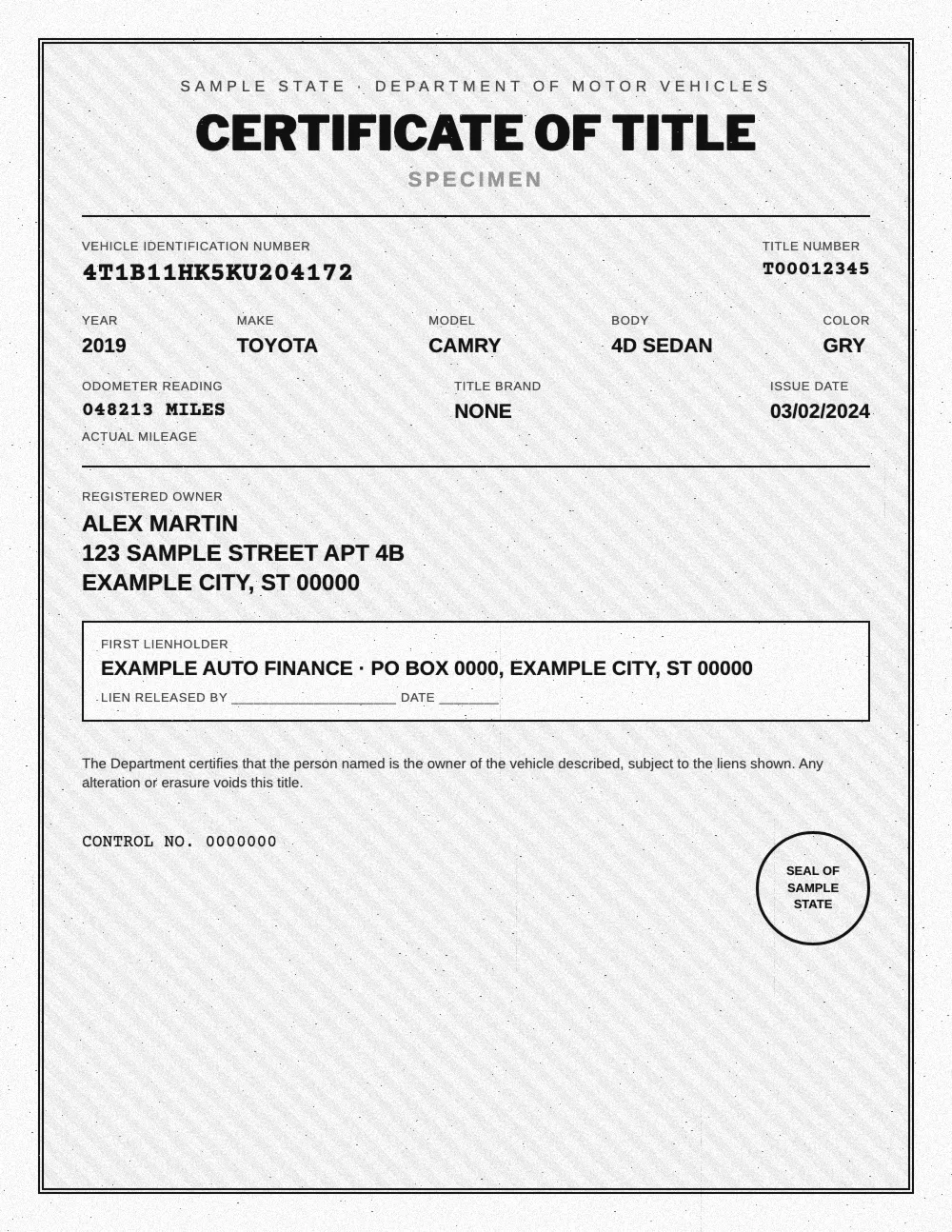
    Specimen certificate of title from a sample state DMV
  2. We spot AI edits and AI generated documents

    We run a proprietary image model trained on fakes. It detects a registration or a title generated in whole or in part by AI from a photo of a real one, as well as a single field rewritten: owner name, title brand, VIN.

    Specimen certificate of title with an AI detection badgeAI detected82/100
  3. We spot picture modifications

    On a scan or a photo, the image itself is analysed: a name pasted over the owner field, digits cloned in the VIN, a white patch over a brand such as SALVAGE, a font that does not match the rest of the document, or a title recomposed from two.

    Owner and lienholder on a specimen certificate of title
  4. We check the VIN, the fields and the rest of the file

    A VIN has 17 characters, no I, O or Q, and a check digit in position 9 that the other 16 must produce. Make, model year and dates must agree with it. The owner and address are then compared with the driver's license and the proof of address in the same file.

    VIN check digit valid
    Make matches the VIN
    Owner matches the driver's license
Pointers

Vehicle registration verification by hand, in three checks

Without a tool, these three checks stop clumsy fakes in a few minutes. A tip: ask for a clear photo of the whole document, front and back for a title, rather than a crop.

Validate the VIN and its check digit

Count 17 characters with no I, O or Q, then compare the VIN with the plate on the dashboard and the label in the door jamb. Position 9 is a check digit computed from the other 16: the NHTSA VIN decoder flags one that fails, a classic sign of a retyped VIN.

Match the owner, the address and the title brands with the file

The owner on the title or registration must match the driver's license, the address the proof of address. Read the brand area: salvage, rebuilt, flood or junk. A clean title on a car with a known past, or an out of state title just reissued, deserves a question.

Confirm the title with the issuing state and NMVTIS

Only the state agency that issued a title can confirm it matches its records, lien included. An NMVTIS vehicle history report, sold by approved providers, shows the latest title data and brands reported across states. Neither looks at the photo you received.

Fraud detection API

Plug vehicle registration fraud detection into your tools with the API

Koncile's fraud detection API gives you a score (0-100) and detailed explanations of manipulation risks, right inside your own tools.

  1. 01

    Field by field OCR extraction

    VIN, plate, owner, brands, dates and lienholder structured.

  2. 02

    Fraud checks explained

    High, medium or low level, with a one sentence explanation.

  3. 03

    Score from 0 to 100

    High risk from 80.

  4. 04

    Quick explanation

    A one line summary ready for your information system.

Request
curl -X POST https://api.koncile.ai/v1/upload_file \  -H "Authorization: Bearer $API_KEY" \  -F "files=@vehicle-title.jpg"
ResponseDONEExample
{  "status": "DONE",  "General_fields": {    "VIN": {"value": "4T1B11HK7KU204172", "confidence_score": 0.98},    "Title_brand": {"value": "NONE", "confidence_score": 0.93}  },  "Fraud_detection": {    "risk_score": 86,    "summary": "VIN check digit fails: position 9 retyped",    "signals": [      {"name": "VIN check digit", "severity": "high"},      {"name": "Image retouching", "severity": "medium"}    ]  }}
Use cases

Vehicle registration verification for insurers, lenders and rental companies

Wherever a title or a registration proves that a vehicle exists and who owns it, a fake costs a policy, a claim paid or a loan with no collateral. Here is where the checker fits in.

Auto insurance underwriting

The registration is read and checked with the driver's license and the rest of the application. An owner or a vehicle that does not match is flagged before the policy is bound.

Theft and total loss claims

The classic scheme: insure, with a stolen or altered title, a vehicle the policyholder never owned, then report it stolen. The document and the owner are checked before payout.

Auto lending

The title is the collateral. Owner, VIN, brands and lienholder are checked against the application, the driver's license and the proof of income in the same file.

Leasing and refinancing

Lease buyouts and refinancing put a title in front of a lender who never saw the car. An existing lien erased from the photo shows up before the funds go out.

Car rental and car sharing

Rental companies and peer to peer platforms receive registrations from owners listing their cars. The registration is checked before the car goes live, with the detail of every test kept.

Dealers and trade ins

A trade in with a washed title or an altered registration may hide a salvage brand, a lien or a theft report. The document is checked before the car joins the lot.

Guide

Altered vehicle titles: what Koncile sees in the file

An altered title or registration can keep a real VIN, a perfect layout and a clean history report. The fake vehicle registration detector relies on signals invisible to the naked eye: in the pixels of the photo, in the consistency of the fields, and in the structure of the file when it is a PDF.

Element of the documentWhat Koncile checksWhat gives an edit away
Image of the documentAreas retouched, rewritten or generated by AI, analysed by our image modelA field rewritten, a name pasted over, a title generated from a photo of a real one
Typography of the fieldsFont, size, alignment and spacing of the characters, compared with the rest of the documentA name or a date retyped in another font, shifted by a few points
VIN17 characters, no I, O or Q, check digit in position 9 (49 CFR Part 565)A check digit that fails, a forbidden character, a VIN too short
Make and model yearMake compared with the manufacturer code at the start of the VIN, model year with its 10th characterA make or a model year that the VIN contradicts
Title brandBrand area read: salvage, rebuilt, flood, junkA white patch or retyped text over a brand, a brand area that does not match the layout
Dates and odometerIssue date, purchase date and odometer reading: order and plausibilityAn issue date before the purchase, odometer digits retyped in another font
Owner and addressCompared with the driver's license and the proof of address in the fileA name or an address that does not match the other documents
LienholderLienholder field compared with the loan or lease applicationA lienholder erased or replaced on a financed vehicle
PDF metadata and versionsProducing software, dates, saved versions, deleted elementsA title reopened in a PDF editor, elements removed after issue
Photo dataDevice, software and dates recorded in the photo (EXIF)A photo that went through editing software before it was sent
Security

Your vehicle titles and registrations handled as personal data

A title or a registration holds a name, an address, a VIN and lien details. Founded by a former lawyer, Koncile was built with data protection at the core of its architecture: third party SOC 2 audit, GDPR compliance, secure hosting. Documents are encrypted, deleted after analysis and never used to train a model.

Read our security documentation
  • SOC 2 badge (AICPA Service Organization Control)
  • GDPR Compliant badge

Vehicle registration verification FAQ

Short answers, with figures when we have them.

Talk to us
  1. It is a tool that combines several technologies to spot the anomalies that give away an edit or a fraud: machine learning that analyses the photo or the scan, and analysis of the PDF file, which is written like code. The goal is to stop the few percent of fakes that slip into your insurance or lending files.

  2. You never know for certain: you measure a risk. It becomes high when one fraud test goes over its threshold, or when several tests point the same way: an edited field on the photo, a VIN check digit that fails, an owner who does not match the driver's license. That body of evidence is what should raise the alarm.

  3. It can help read the fields and spot an inconsistency in context. It lacks three things: models specialised in images edited or generated by AI, knowledge of the traces each editing tool leaves, and a base of reference documents that brings the mismatches out. A language model is only one part of the machine.

  4. It depends on your volume. The price combines a base subscription and a cost per page or per document processed. The plans are detailed on the pricing page.

  5. Each VIN character gets a value, multiplied by a weight for its position. The sum is divided by 11, and the remainder, or X for 10, must be the ninth character (49 CFR 565.15). A failing check digit often means a retyped VIN. A valid one proves consistency, not that the vehicle exists.

  6. Title washing hides a vehicle's past, such as a salvage, flood or junk brand, by retitling it in a state with different rules or by altering the title itself. NMVTIS was built to deter it by sharing title data across states. On a photo of a title, a brand area edited or erased is what Koncile looks for.

  7. Only the state motor vehicle agency that issued the title can confirm it matches its records, lien included. An NMVTIS report from an approved provider shows the latest title data and brands across states. Koncile does not query these registries: it checks the document you received, its image, its fields and its file.

  8. Yes. Under federal law a motor vehicle title counts as a security, and transporting a forged or altered one across state lines with fraudulent intent carries up to 10 years in prison (18 U.S.C. §§ 2311 and 2314). States add their own title fraud offenses. If you receive a fake, keep the original file and the analysis report.

  9. Yes. Koncile complies with SOC 2 and GDPR, and an independent firm certifies our security and data protection. Your documents are hosted securely with a provider that itself holds SOC 2 and ISO 27001 certifications.

Try Koncile's fraud detection on your own documents

Upload your bank statements, pay stubs or IDs: Koncile extracts the data and flags fakes in seconds.

Talk to an expert