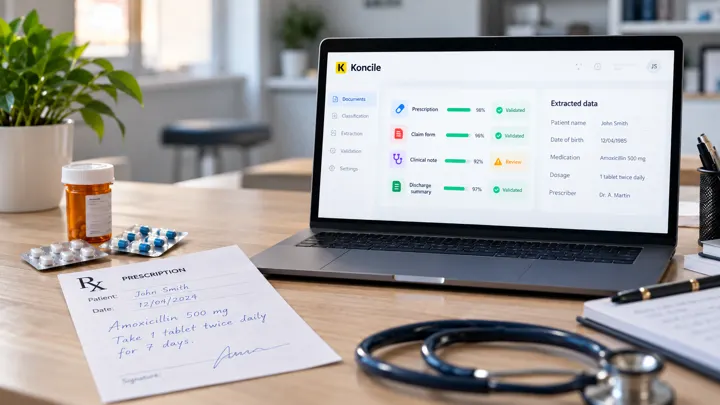
Google Document AI, Amazon Textract, Microsoft Azure AI Vision. Ask for an OCR recommendation and those three names come up first almost every time, and almost every time they're American. For a French or European company running document extraction on invoices, contracts, and payroll data, that's not a neutral fact. Those documents carry financial data, personal information, and sensitive contractual terms, and routing them through US-based servers means accepting a partial loss of control over that data under US law, regardless of where your company is headquartered.
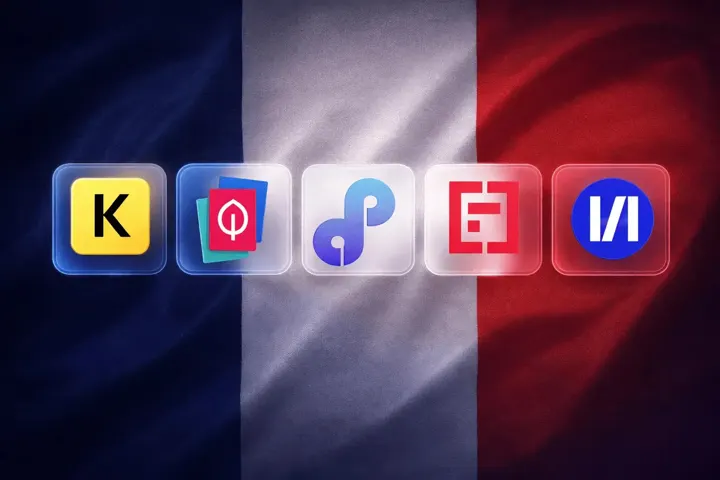
Five French OCR solutions compete directly with the American options on accuracy while keeping that data on French soil. This is what actually differentiates them from each other, not just the fact that they're French.
What "French OCR" actually needs to mean
Being a French company isn't the same as offering real data sovereignty, and it's worth being specific about what to check rather than taking "hosted in France" as a self-certifying claim. The concrete things that matter: where the servers physically sit, whether the vendor is GDPR compliant as a baseline (which is legally required for any EU-facing vendor, French or not) versus holding an independent certification like SOC 2 on top of that, and whether support and contacts are based in France or routed through a larger multinational's generic support queue.
All five solutions below clear the hosting bar. Where they actually differ is specialization, and that's the part worth spending time on.
1. Koncile: broadest document coverage, with fraud detection built in
Koncile is used by thousands of accounts for invoice OCR, processing invoices, purchase orders, bank statements, contracts, and logistics documents. What differentiates it from most general OCR tools isn't just reading text off a page, it's understanding document structure: identifying key fields like vendor, amount, and date, and extracting line items with their descriptions, quantities, and individual amounts rather than one flat text block.
The platform handles the full chain around extraction too, not just the extraction itself: automatic document classification, intelligent page splitting, and workflow automation. Since 2026, it has added document fraud detection specifically in response to the rise of AI-generated and AI-edited fake documents, a capability that reads as much about whether a document has been altered as what it actually says.
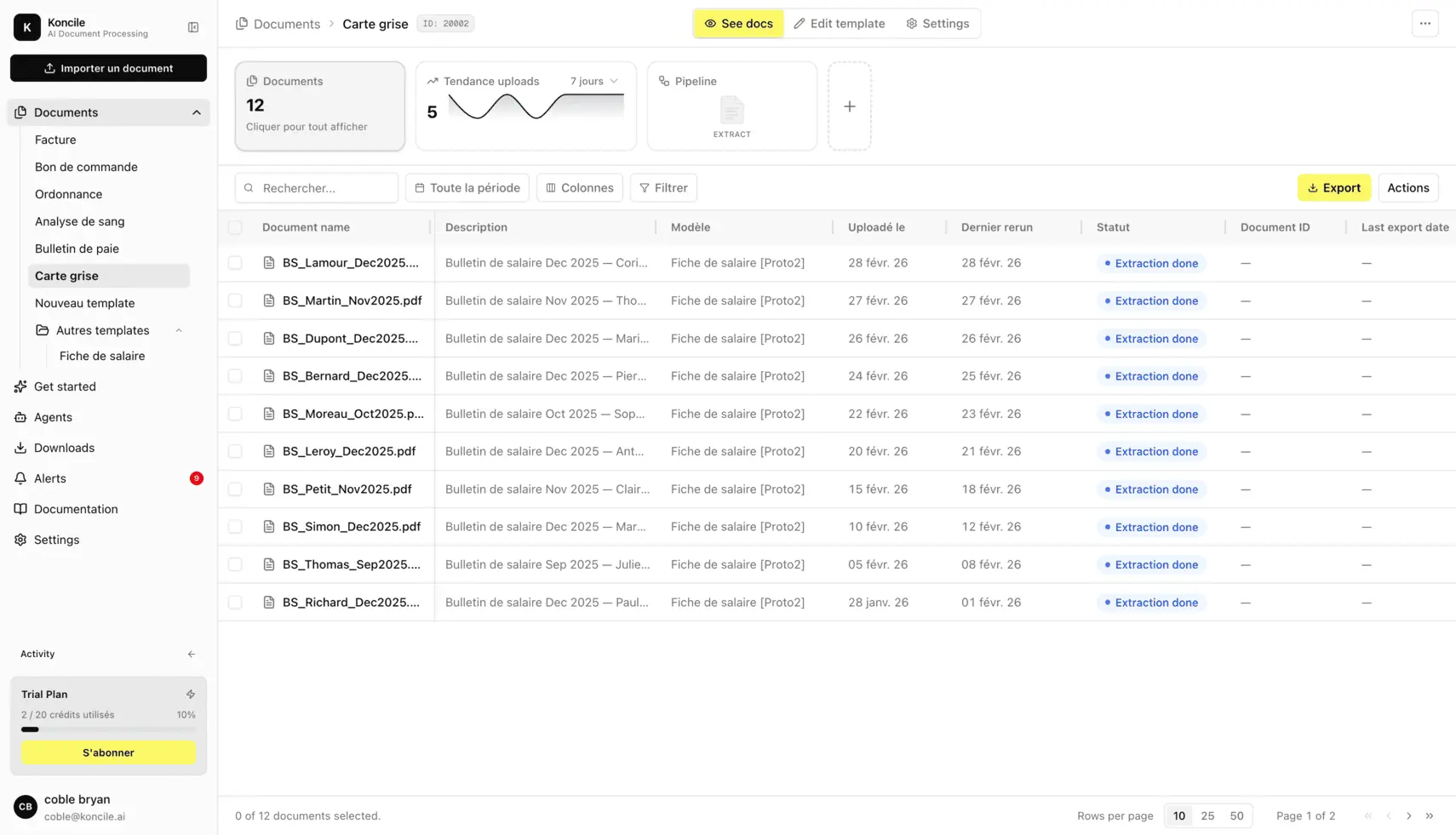
Enterprise clients including Epson and Servier, and the Cerfrance accounting network serving more than 320,000 businesses across France, use Koncile in production. Pricing is per-page with published tiers rather than a quote-only enterprise model, and both a documented API and an MCP server are available for connecting to AI agents directly.
2. Mindee: the developer-first API, and the one with real published pricing
Searches for Mindee OCR consistently point to the same thing: a Paris-based OCR API platform, founded in 2018, with pre-trained models for invoices, receipts, bank statements, and identity documents. It's also the creator of docTR, a genuinely popular open-source Python OCR library, worth knowing if your team wants a free, self-hosted starting point before committing to a paid API.
Mindee's pricing is the most transparent of the five covered here: a free tier processing up to 250 pages a month with no credit card required, then a Starter plan at €44 a month for 6,000 credits, roughly €0.044 per page, scaling up through Pro and custom Enterprise tiers. SDKs are available in Python, Java, and PHP. G2's Fall 2026 report named Mindee a High Performer in both the IDP and OCR categories, based on user reviews rather than a vendor-submitted claim, which is a more useful signal than most awards pages offer. The tradeoff for that developer-first design: Mindee focuses specifically on field extraction and doesn't cover document splitting or broader workflow automation the way a full IDP platform does, so plan on building that layer yourself if you need it.
3. reciTAL: built for the hardest fiscal documents specifically
reciTAL runs shared cloud hosting on OVH servers in France, with dedicated cloud or on-premise deployment available for organizations that need it. The platform is positioned specifically around long, complex fiscal and accounting documents, balance sheets and tax returns, structured or not, and reciTAL states a 98 percent automation rate on that document category specifically.
What makes fiscal documents specifically hard is the combination of length and inconsistency: a balance sheet or tax return runs many pages, mixes dense tables with free-text notes, and rarely follows the same template twice between filers, let alone between countries. That's a genuinely different problem from reading a one-page invoice, and it's the reason reciTAL built around that document category specifically rather than trying to be a general-purpose tool that also happens to handle fiscal filings.
The positioning here skews toward large enterprises and public administrations rather than smaller teams, which tracks with the deployment options on offer. On-premise and dedicated cloud exist specifically for organizations where a shared multi-tenant cloud service isn't an acceptable answer regardless of where the servers physically sit, government agencies and some financial institutions most often fall into that category, but that same requirement adds real deployment time and cost that a small accounting firm typically can't justify.
4. Yooz: accounts payable at genuinely large scale
Yooz has actually grown past the numbers most comparisons, including earlier versions of this one, still cite. As of a June 2026 milestone, Yooz reports more than 7,000 business customers and over 300 million financial documents processed, not the 5,000 customers and 100 million invoices figure that circulates in older write-ups. The platform connects to more than 250 ERPs and is built specifically around accounts payable: approval workflows, duplicate payment detection, and vendor statement reconciliation.
That AP-specific focus is both the strength and the limit. If supplier invoice processing is genuinely the whole problem, Yooz is a mature, turnkey answer built for finance teams rather than engineering teams. If you need to process contracts, HR documents, or logistics paperwork through the same platform, that's outside its scope by design.
5. Docloop: the one built specifically for logistics paperwork
Docloop handles the document types that trip up general-purpose OCR tools most often: bills of lading, delivery notes, and transport invoices, formats with enough layout variability between carriers and countries that a model trained mainly on standard invoices tends to struggle. Hosting is based in France, and the tool is aimed specifically at supply chain and logistics companies rather than general back-office use.
The specific reason transport documents break generic OCR is worth spelling out rather than just asserting: a bill of lading issued by a shipping line looks nothing like one issued by a freight forwarder, and both look nothing like a customs-adjacent delivery note, even though all three carry overlapping information, consignee, cargo description, weight, container numbers. A model trained mainly on invoices has never seen that specific layout diversity, so it either misreads the fields or needs a new template built for every carrier a company works with. That's exactly the maintenance burden a purpose-built tool is designed to avoid.
That specialization is exactly why it's worth including here rather than treating it as a lesser general OCR tool: for a logistics-heavy operation, purpose-built handling of transport document variability matters more than broad document-type coverage.
Which one actually fits your situation
If you need one platform that handles many different document types with both field and line-item extraction, plus fraud detection and workflow automation, and data sovereignty matters, Koncile covers the broadest ground. If you're a technical team that wants to embed OCR into your own product quickly and want to see real pricing before talking to sales, Mindee's API and published rates are the fastest path. If your documents are specifically complex fiscal filings and you need on-premise or dedicated deployment for compliance reasons, reciTAL is built for exactly that. If supplier invoice processing for accounts payable is the entire problem, Yooz is a mature, turnkey option at genuine scale. And if your documents are logistics paperwork specifically, bills of lading, delivery notes, transport invoices, Docloop's specialization is the actual differentiator, not a limitation.
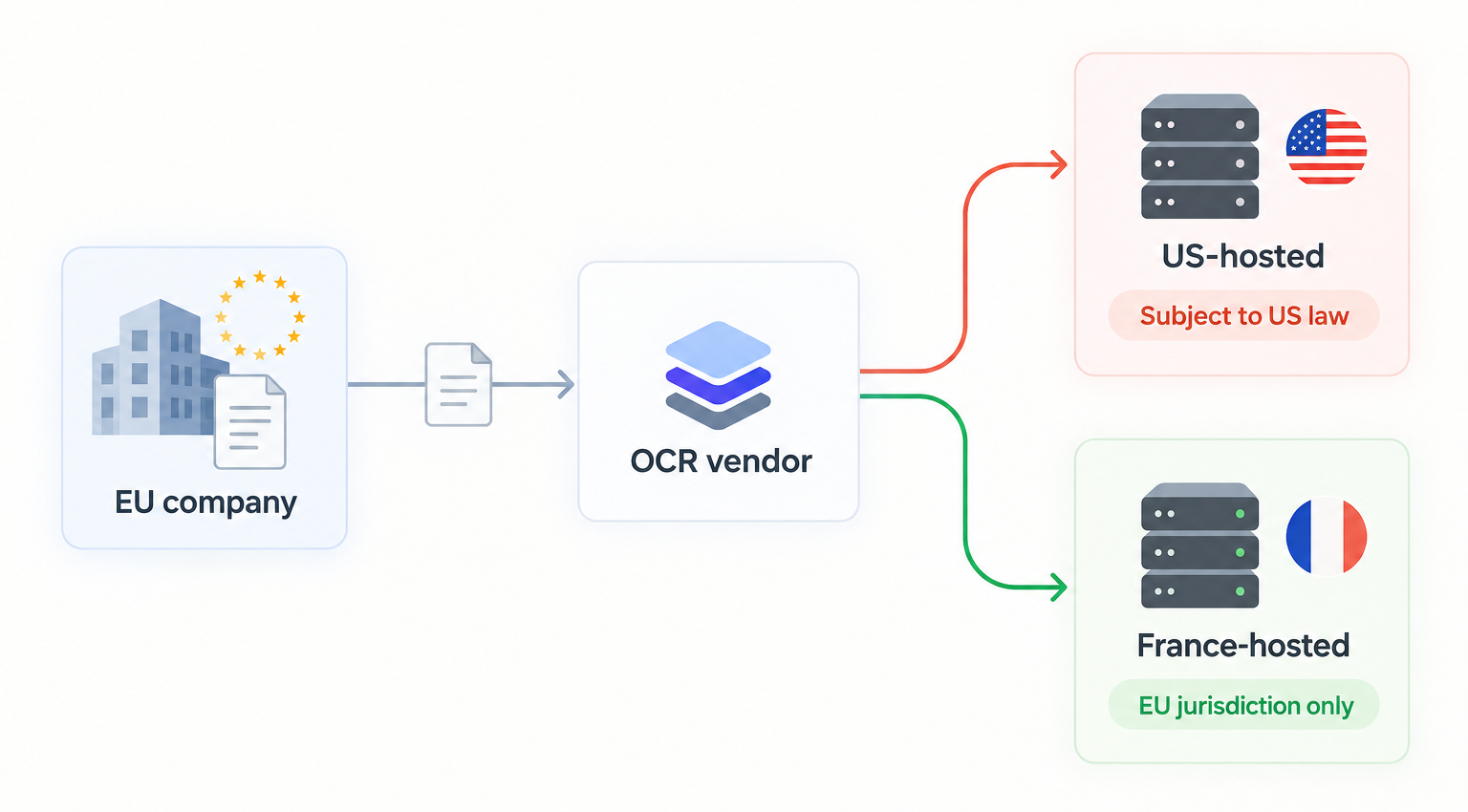
What's true across all five: choosing a French OCR solution is no longer a real tradeoff against accuracy. The gap that used to exist between French tools and the big three American platforms has closed enough that the decision now comes down to document type and workflow fit, the same question worth asking of any intelligent document processing vendor regardless of where it's headquartered, with data residency as a genuine added benefit rather than a compromise.
Your questions about French OCR solutions
Is there a French OCR solution specialized in logistics documents?
Yes, Docloop is built specifically for transport and logistics paperwork, bills of lading, delivery notes, and transport invoices, document types with enough layout variability between carriers that general-purpose OCR tools often struggle with them. Hosting is based in France.
Sources
- Vendor pricing and product pages for Koncile, Mindee, reciTAL, Yooz, and Docloop, accessed September 2026.
- Independent 2026 reviews and comparisons cross-referenced for Mindee pricing consistency across multiple sources.
- Yooz company milestone reporting, June 2026, on customer count and documents processed.